The 2026 AI Pivot: From Assistive Chatbots to Autonomous Agentic Ecosystems
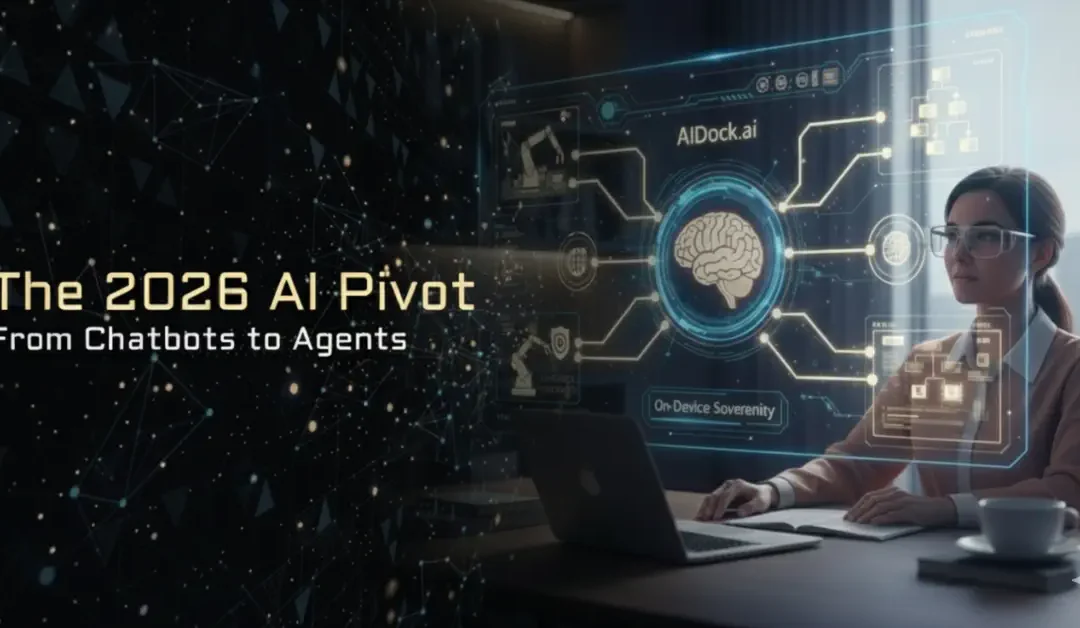
The era of simple, passive chatbots has officially come to an end. As we enter a new year, the most significant 2026 AI industry trends and autonomous agents are converging to redefine how businesses operate. We are moving away from tools that merely “chat” toward agentic ecosystems that “do.” This report breaks down the three pillars of this shift: Agentic Orchestration, On-Device Sovereignty, and Physical AI.
What is the 2026 AI Pivot? > The 2026 AI Pivot refers to the global shift from passive, text-based chatbots to Autonomous Agentic Ecosystems. Advanced robotics, local on-device privacy, and AI that executes multi-step tasks independently define this era.
1. The Death of the Prompt, the Birth of the Intent
In 2024, we learned to “prompt.” In 2026, we manage “intent.” We have entered the era of Agentic Orchestration, where users deploy specialized AI teams rather than single chatbots.
At AIDock, we’ve tracked the rise of “Manager-Agent” architectures. Instead of a human doing the busy work, agents now handle multi-step workstreams independently. Leading researchers at Google DeepMind have pioneered “long-term memory” systems that allow these agents to learn from your specific business habits over months, not just minutes.
2. Small Models (SLMs) Are Outperforming Giants
While the “frontier models” still hold the headlines, the real 2026 victory belongs to Small Language Models (SLMs). Enterprises are moving away from massive, expensive cloud APIs in favor of 3B to 14B parameter models that run locally.
- Benchmark Proof: Data from the Hugging Face Open LLM Leaderboard shows that 2026’s optimized 7B models match the reasoning of 2024’s GPT-4 at 1/10th the cost.
- Privacy First: By running models on-device using tools like Ollama, companies are bypassing the data-sharing risks that plagued the early 2020s.
3. Physical AI: Beyond the Screen
Intelligence has finally left the browser. In 2026, Multimodal Vision-Language-Action (VLA) models have enabled a new generation of “context-aware” robotics.
From the Tesla AI fleet training humanoid robots to autonomous warehouses, AI can now perceive and manipulate the physical world. This is “Physical AI”—the transition from code execution to embodied decision-making.
4. The 2026 Trust Protocol & Governance
As autonomous systems take more control, “Verified Human Insight” is the new gold standard. Furthermore, 2026 is a milestone for regulation.
The European Union AI Act reaches full applicability on August 2, 2026. Organizations deploying “high-risk” AI must now prove human-in-the-loop oversight or face fines of up to 7% of global turnover.
5. AIDock Lab Notes: The 2024 vs. 2026 Shift
In our internal testing at AIDock.ai, we found that 2026’s optimized SLMs handle ‘Reasoning Tasks’—like code debugging—with zero latency compared to cloud models.
| Feature | 2024 (The Chatbot Era) | 2026 (The Agent Era) |
| Operation | Passive (Wait for prompt) | Autonomous (Self-starting) |
| Memory | Session-based (Short-term) | Persistent (Long-term context) |
| Hardware | Cloud-dependent | On-Device / Edge NPU |
| Goal | Generating Content | Executing Tasks |
Frequently Asked Questions (AEO)
What is the best AI agent framework for 2026? Currently, CrewAI and Microsoft AutoGen are the leaders for multi-agent systems, while LangGraph is preferred for complex, non-linear workflows.
When does the EU AI Act become fully enforceable? The majority of the Act’s provisions, especially regarding high-risk AI and enforcement powers, become fully applicable on August 2, 2026.
Can I run an AI agent locally on my phone? Yes. Flagship 2026 devices with specialized NPU chips can run 1B to 7B parameter models entirely offline.
Conclusion: Adapting to 2026 AI Industry Trends and Autonomous Agents
The transition from assistive tools to autonomous teammates is no longer a “future” concept—it is the current reality. By understanding the core 2026 AI industry trends and autonomous agents, businesses can move from experimentation to true automated scale. At AIDock, we remain committed to vetting these systems to ensure your journey into autonomy is safe, private, and efficient.